You’ve probably heard the term “skin graft” in a hospital corridor, a medical drama, or after someone you love came home from an accident. But what does it actually mean? What happens during the procedure? And most importantly — will it work for you?
As someone who has performed hundreds of reconstructive procedures over 18+ years, I want to give you the kind of honest, plain-language explanation that most medical websites don’t bother to write.
So let’s start from the very beginning.
What Is Skin Grafting, Really?
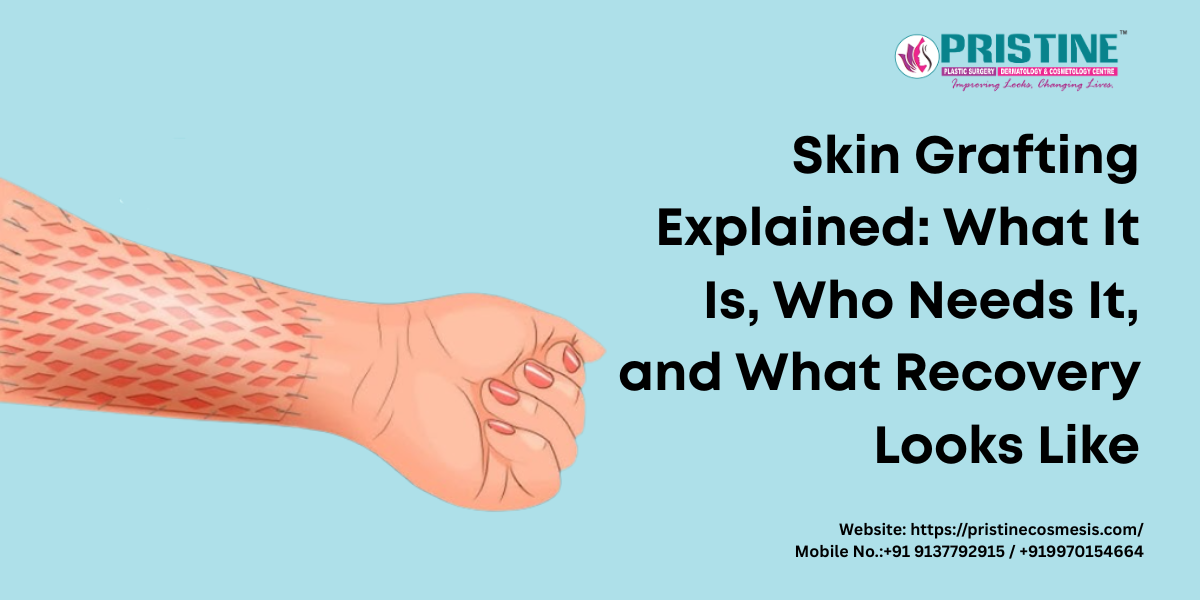
Skin grafting is a surgical procedure where healthy skin is taken from one part of your body — called the donor site — and used to cover an area where the skin has been lost, damaged, or destroyed.
Think of it like patching a tear in fabric. Except the fabric is your body, and the patch is living tissue that, over time, grows and integrates with the area around it.
The skin we transplant isn’t artificial. It isn’t synthetic. It’s your own skin — moved from a place where you have plenty to spare, to a place where you have none left.
Why Would Someone Need a Skin Graft?
This is the question most patients ask first, and rightly so. Skin grafting becomes necessary when the skin damage is too deep or too large to heal on its own.
Here are the most common reasons we perform this procedure at Pristine Cosmesis:
Burn injuries — Deep burns destroy multiple layers of skin. Without grafting, these wounds either won’t heal at all, or they’ll heal poorly, leaving thick, painful scars and restricted movement.
Traumatic wounds — Road accidents, industrial injuries, and falls can strip away skin from large areas. In Thane, where many patients come from both industrial zones and residential areas, we see a significant number of these cases.
Diabetic and chronic wounds — Diabetic foot ulcers that refuse to heal despite months of dressing changes often need a skin graft to finally close.
Post-surgical defects — When a tumour or cyst is removed and the wound left behind is too large to stitch directly, a graft helps cover it safely.
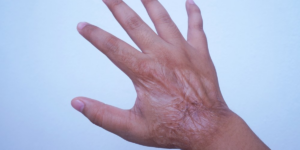
Contractures from old burns or scars — Sometimes old burn injuries tighten over time and restrict the movement of a joint — a finger, an elbow, a knee. Releasing and grafting these areas can restore function that patients thought they’d lost forever.
If you’re searching for the best skin grafting in Thane, the most important thing isn’t just finding a clinic — it’s finding a surgeon who understands reconstructive principles, not just cosmetic ones.
Are There Different Types of Skin Grafts?
Yes — and the type used depends entirely on your wound, your general health, and what outcome we’re trying to achieve.
Split-thickness skin graft (STSG) — The most commonly used type. A thin layer of skin (including the outer layer and part of the middle layer) is harvested from areas like the thigh or back. This is used for large wounds, burns, and ulcers.
Full-thickness skin graft (FTSG) — A thicker piece of skin including all layers is taken, usually from the groin, neck, or inner arm. Used for smaller, more visible areas like the face or hands, where appearance and texture matter more.
Composite graft — Used in very specific cases like nasal reconstruction, where skin alone isn’t enough — cartilage needs to move with it.
The choice of graft type is not a one-size-fits-all decision. At Pristine Cosmesis, every patient’s plan is decided after a thorough examination and discussion — never before.
What Happens During the Procedure?
I want to explain this in a way that reduces fear, not increases it.
You will be given anaesthesia — local, regional, or general, depending on how large the area is. You won’t feel pain during the procedure.
The surgeon carefully harvests the graft from the donor site — this leaves a wound there too, but it heals on its own, similar to a graze, within two to three weeks.
The graft is then placed over the wound area, secured with sutures or staples, and covered with a protective dressing. Sometimes a device called a VAC (Vacuum Assisted Closure) is applied to help the graft take.
The procedure itself, depending on complexity, typically takes one to three hours.
What Does Recovery Actually Look Like?
This is the part most websites skip — and it’s the part patients care most about.
Week 1 to 2 — The graft is “taking” The graft needs to form new blood vessel connections with the wound bed beneath it. During this time, you must keep the area completely immobile and protected. Movement — even small amounts — can disrupt this process. This is why we ask patients to rest strictly in the first two weeks.
Week 2 to 4 — Early healing If the graft has taken well, the area begins to look pink and feel slightly tight. The donor site is usually healing well by now too. You may be allowed to move more, depending on where the graft is.
Month 1 to 3 — Maturation The graft begins to blend with surrounding skin. It may look slightly different in colour or texture initially — this is completely normal. Moisturising and sun protection are critical during this phase.
Month 3 to 12 — Long-term result Most grafts settle and soften significantly over time. The colour difference reduces. Patients are often amazed by how natural the area looks 6 to 12 months later — especially when the surgery was done correctly from the start.
Patients seeking the best skin grafting in Thane often come to us after failed attempts elsewhere — and in many of those cases, the issue wasn’t the graft itself, it was inadequate post-operative care and follow-up.
Will It Leave a Scar at the Donor Site?
Honest answer — yes, to some degree. The donor site will heal, but it will leave a flat, pale area. In most patients, this fades considerably within six to twelve months and is easily hidden under clothing.
We always choose donor sites that are discreet — your thigh, your upper back, or your abdomen — depending on what your lifestyle and clothing choices allow.
Is Skin Grafting Painful?
During the procedure — no, because you are anaesthetised.
After — there is discomfort, particularly at the donor site, which can feel like a scraped wound for the first week. Pain medication manages this very effectively. Most patients are surprised to find it is far more manageable than they expected.
About Dr. Nikhil Ghubade
Dr. Nikhil Ghubade is a Board-Certified Plastic, Cosmetic, Reconstructive, Burns and Hands Surgeon with 18+ years of clinical experience. He completed his MCh in Plastic Surgery, trained at the prestigious KEM Hospital in Mumbai, completed a fellowship at TSGH in Taiwan, and holds an international observership from New York.
He has performed complex reconstructive procedures including free flap surgeries, burn contracture releases, trauma wound closures, and skin grafting for patients across Thane, Mumbai, and beyond. His work extends beyond the clinic — he has been involved in social service camps serving burn survivors and underprivileged patients who would otherwise have no access to reconstructive care.
At Pristine Cosmesis Centre, Dr. Nikhil works alongside Dr. Dhanyata Ghubade-Phadte — a Board-Certified Dermatologist, Trichologist and Cosmetologist giving patients access to both surgical and non-surgical skin expertise under one roof, in the heart of Thane.
When Should You Come in for a Consultation?
If you or someone you care for has:
-
A wound that isn’t healing despite weeks of dressing
-
A deep burn covering a significant area of skin
-
A post-surgical defect or tumour removal site that needs coverage
-
An old burn scar causing tightness or restricting movement
-
A traumatic injury that has left a large open area
don’t wait. The longer a wound remains open, the harder it becomes to treat.
Getting the best skin grafting in Thane starts with a proper, unhurried consultation where we look at your wound, understand your health, and explain your options honestly.