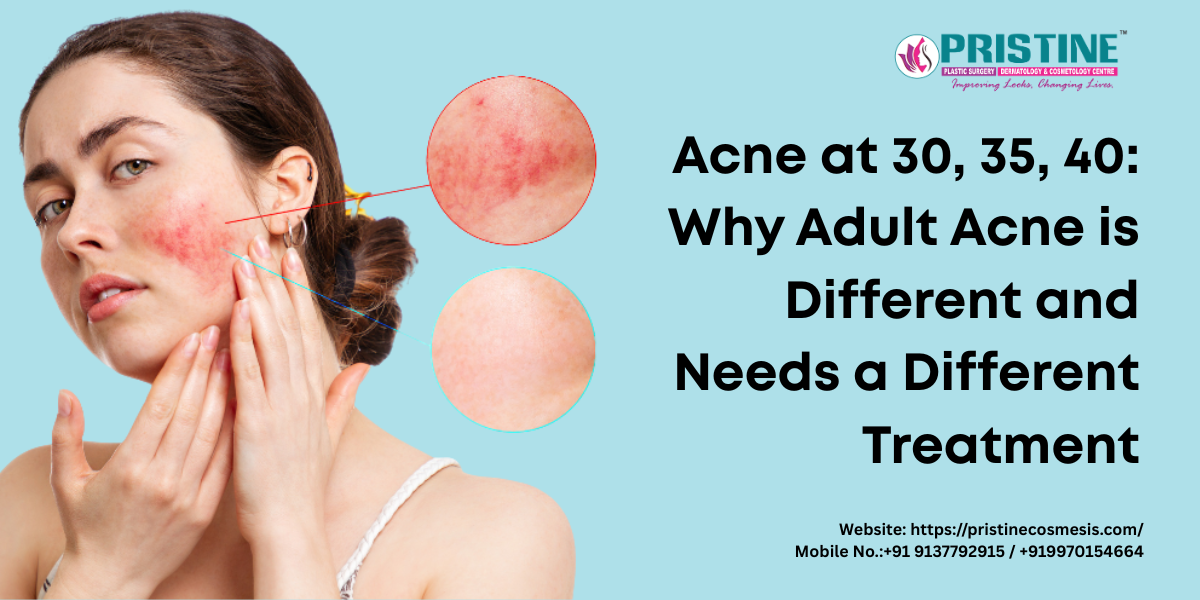
You thought acne was supposed to be a teenage problem. So why is it still here?
If this sounds familiar, you are not alone and more importantly, you are not doing anything wrong. Adult acne, especially in women, is one of the most common and most misunderstood skin conditions I see at my clinic every single week.Women in their 30s, 35s, even early 40s walk into Pristine Cosmesis feeling frustrated and confused many of them having already searched for acne scars treatment in Thane without knowing where to actually start.
It does not. And today I want to explain exactly what is happening, why it is different from teenage acne, and what actually works.
First, Let’s Talk About Why Adult Acne Feels So Different
Teenage acne and adult acne may look similar on the surface — but underneath, they are driven by completely different forces.
When you were 15, acne was largely triggered by a surge of androgens during puberty. Your oil glands went into overdrive, pores clogged, bacteria got involved, and breakouts appeared — usually across the forehead, nose, and cheeks.
Adult acne in women tells a very different story.
In my 14 years of practice, I have noticed that adult acne tends to be:
- Deeper and more painful — often cystic, forming under the skin rather than on top of it
- Concentrated on the lower face — jawline, chin, and neck rather than the T-zone
- Cyclical — appearing predictably before or during your period
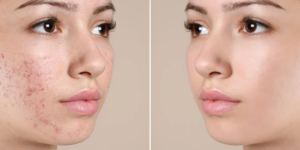
- Slower to heal — and far more likely to leave behind dark marks or scars
- Resistant to standard acne products — the salicylic acid face wash you used at 17 simply will not cut it anymore
The reason for all of this? Hormones. But not just puberty hormones — the more complex, fluctuating hormones of your adult womanhood.
The Real Reasons You Are Breaking Out in Your 30s and 40s
1. Hormonal Fluctuations
This is the number one driver of adult female acne. Estrogen and progesterone levels shift constantly — across your menstrual cycle, during perimenopause, after stopping or starting birth control, and during pregnancy. These fluctuations stimulate the sebaceous glands to produce more oil, and that excess oil, combined with dead skin cells, clogs the pores and causes breakouts.
PCOS (Polycystic Ovary Syndrome) is a particularly common culprit I see in my patients. It raises androgen levels in women, which directly triggers acne — often accompanied by irregular periods, hair thinning on the scalp, and unwanted facial hair. If your acne is stubborn and comes with any of these signs, it is worth investigating beyond the skin.
2. Chronic Stress
Stress triggers the release of cortisol — your body’s primary stress hormone. Cortisol signals the sebaceous glands to produce more oil. In our working lives — deadlines, commutes, family responsibilities — cortisol is rarely low. Women in their 30s and 40s are often managing the most demanding phase of their professional and personal lives simultaneously. The skin reflects this burden.
3. Skincare Products That Are Too Harsh — Or Too Heavy
Here is something that surprises many of my patients: aggressive acne products can actually make adult acne worse. Products designed for teenage oily skin strong benzoyl peroxide washes, alcohol-heavy toners, heavy exfoliants strip the skin barrier of women in their 30s and trigger a rebound in oil production. On the other end, rich anti-ageing creams that you may have started using can be too occlusive and clog pores.
The balance is delicate. And it changes as you age.
4. Diet and Gut Health
High glycaemic foods — white rice, sugary drinks, processed snacks spike insulin levels, which in turn stimulates oil production. Dairy has also been linked to acne in some women due to the hormones naturally present in milk. While diet alone rarely cures acne, it is a contributing factor that I always explore with my patients.
5. Perimenopause
Women in their early to mid-40s are often entering perimenopause the transition period before menopause. Estrogen begins to decline, and its protective effect on the skin diminishes. Relatively higher androgen levels take over, and acne can appear for the first time in decades — or worsen significantly in women who have always been prone to it.
Why Over-the-Counter Products Are Not Enough
Walk into any pharmacy and you will find shelves full of acne products. Face washes, serums, spot treatments all promising clear skin. And many of my patients have tried most of them before they come to see me.
The problem is that over-the-counter products treat the surface symptom of the visible pimple without addressing the underlying cause. If your acne is hormonal, no amount of salicylic acid will regulate your estrogen levels. If it is driven by PCOS, a face wash will not fix your androgen imbalance.
This is why adult acne needs a personalised, medically informed treatment plan not just a better product.
What a Dermatologist Actually Does Differently
When a patient comes to me at Pristine Cosmesis with adult acne, my approach is never one-size-fits-all. Here is what a proper evaluation looks like:
Detailed skin and medical history — I ask about your menstrual cycle, stress levels, diet, medications, skincare routine, and family history. Acne is a systemic condition, not just a skin problem.
Hormonal assessment — In cases of suspected hormonal imbalance or PCOS, I recommend blood tests to check androgen levels, thyroid function, and blood sugar. Treating the internal imbalance is often the key to clearing the skin.
Customised prescription treatment — depending on your skin type, severity, and root cause, this may include topical retinoids, azelaic acid, niacinamide-based formulations, oral medications, or hormonal therapy in coordination with a gynaecologist.
In-clinic procedures — for active acne and the scarring it leaves behind, we offer a range of treatments at Pristine Cosmesis including chemical peels, laser therapy, microneedling, and PRP — all chosen specifically for your skin’s current condition and age.
A Word About Acne Scars
One thing that deeply concerns my patients — often more than the acne itself — is the scarring and pigmentation it leaves behind. And rightfully so. Adult skin heals more slowly than teenage skin, and dark marks can linger for months or even years without proper treatment.
If you are struggling with this, please know that acne scars treatment in Thane has advanced significantly. At Pristine Cosmesis, we use a combination of fractional laser, chemical peels, and microneedling to resurface the skin and stimulate collagen — effectively reducing both the depth of scars and the discolouration. The key is to start treatment early, before scars become deeply embedded.
The Emotional Side of Adult Acne — Let’s Not Skip This
I need to say something that the medical textbooks rarely do.
Adult acne is emotionally exhausting in a way that is unique to this stage of life. As a teenager, acne is almost expected of your peers going through it too. But at 35, when you are a professional, a mother, a partner, breakouts can feel deeply isolating. They affect how you show up in meetings, how you feel in photographs, how comfortable you are in your own skin.
Many of my patients tell me they have stopped wearing certain clothes, avoided events, or felt their confidence quietly shrink because of their skin. That is real. And it matters.
Treating adult acne is not vanity. It is health physical and mental. You deserve to feel comfortable in your skin at every age, and seeking professional help is one of the most self-respecting things you can do.
What You Can Do Starting Today
While you plan your consultation, here are some evidence-based habits that support clearer skin:
- Switch to a gentle, non-comedogenic cleanser — no stripping, no scrubbing
- Add niacinamide to your routine — it regulates oil, reduces inflammation, and fades marks
- Always wear sunscreen — SPF 30 or above, every single day, rain or shine. Unprotected sun exposure darkens acne marks significantly
- Reduce high-glycaemic foods — swap refined carbs for whole grains where possible
- Do not pick or squeeze — I know. It is very hard. But every squeeze deepens scarring
- Manage stress actively — even 10 minutes of breathwork or walking counts
When to See a Dermatologist
Please do not wait. Come in if:
- Your acne is painful, deep, or cystic
- It is appearing along the jawline and chin persistently
- Over-the-counter products have not worked after 8 weeks
- You are noticing acne scars or dark marks
- Your acne comes with other hormonal symptoms like irregular periods or hair loss
You Are Not Alone — And You Do Not Have to Figure This Out Alone
If you are dealing with adult acne in Thane, I want you to know that what you are experiencing has real, treatable causes. The right acne scars treatment in Thane and the right acne prevention plan starts with understanding what is actually driving your breakouts, not just what is visible on the surface.
At Pristine Cosmesis Centre in Thane, we take a thorough, compassionate, science-backed approach to adult acne because your skin at 30, 35, or 40 deserves more than a generic face wash recommendation. Book Your Consultation with Dr. Dhanyata Ghubade Board-Certified Dermatologist, Cosmetologist & Trichologist | 14+ Years Experience | Pristine Cosmesis Centre, Thane.