I see this every single day at my clinic as a dermatologist in Thane. A patient walks in, holds up her phone showing a home remedy she found online, and says — “Doctor, I think it’s sun tan. This turmeric pack should work, right?
Sometimes she’s right. But more often than not, what she thinks is a simple tan is actually melasma or post-inflammatory pigmentation, two conditions that get dramatically worse with the wrong treatment.
And that’s the problem. Melasma, pigmentation, and sun tan look similar on the surface. But they have completely different causes, completely different treatments, and completely different outcomes if you ignore them or treat them incorrectly.
So today, let me break it down for you the way I explain it to my patients sitting across from me every morning here in Thane.
First, Why Does Skin Darken in Summer at All?
Before we separate these three conditions, you need to understand one common thread — melanin.
Melanin is the pigment that gives your skin its colour. Your skin produces more of it when it’s under stress — whether that stress is UV rays, hormones, inflammation, or injury. Think of melanin as your skin’s defense shield.
The problem? That shield sometimes overreacts. And depending on why it’s overreacting, the darkening looks and behaves very differently.
That’s exactly where most women go wrong — they treat the symptom (dark skin) without identifying the root cause.
Sun Tan — The Most Common, The Most Temporary
Let’s start with the most familiar one.
A sun tan happens when ultraviolet radiation from the sun directly stimulates your melanocytes (pigment-producing cells) to produce more melanin. It’s essentially your skin trying to protect itself from UV damage.
What it looks like:
- Uniform darkening across sun-exposed areas — face, neck, arms, hands
- It follows your clothing line exactly (you’ll be lighter where your dupatta or collar covered you)
- The skin tone is even — no patches, no isolated spots
- It usually appears within hours to days of sun exposure
Who gets it: Everyone. But people with naturally wheatish or medium skin tones in Thane tend to tan more visibly because of our high UV index — especially between March and July when the sun is at its harshest.
The good news: A sun tan is the most reversible of the three. With proper sun protection, gentle exfoliation, and the right brightening ingredients — Vitamin C, kojic acid, alpha-arbutin — most tans fade within 3–6 weeks.
What not to do: Please stop scrubbing aggressively. I see patients who have scrubbed their skin raw trying to remove a tan faster. That inflammation? It often triggers the next condition on this list.
Post-Inflammatory Hyperpigmentation (PIH) — When Your Skin “Remembers” an Injury
This one surprises most of my patients because they don’t connect the darkening to something that happened weeks or even months ago.
Post-inflammatory hyperpigmentation occurs when your skin produces excess melanin at the site of inflammation or injury. That inflammation could be from acne, a rash, an allergic reaction, a wax burn, aggressive scrubbing, or even a minor cut.
What it looks like:
- Dark spots or patches at the exact location of a previous pimple, rash, or injury
- Flat, not raised — the texture of the skin underneath is completely normal
- Can be light brown, dark brown, or even greyish depending on your skin tone
- Does not follow sun exposure patterns — you’ll find spots even in areas not exposed to the sun
Why summer makes it worse: Even though PIH starts from inflammation, UV exposure dramatically darkens those spots further. So if you already have PIH from a winter acne breakout, summer sun will make those marks look 3–4 shades darker. This is why patients come to me in June saying — “My acne is gone but my face looks worse than ever.”
What actually works: Niacinamide, azelaic acid, and retinoids (used carefully in summer) are the gold standard. Chemical peels — done at the right time and by a qualified dermatologist — can significantly reduce PIH. At Pristine Cosmesis, I’ve treated hundreds of PIH cases and the results with a proper, personalised protocol are genuinely transformative.
What doesn’t work: Home bleaching creams with mercury or high-dose steroids. These creams are sold openly in Thane markets and they make PIH worse in the long run while causing additional skin damage that is very difficult to reverse.

Melasma — The Most Stubborn, The Most Misunderstood
And now we come to the one that requires the most careful conversation — melasma.
Melasma is a chronic pigmentation disorder triggered primarily by hormonal changes and UV exposure. It is not just a cosmetic concern — it is a medical condition that requires a long-term management plan, not a quick-fix cream.
What it looks like:
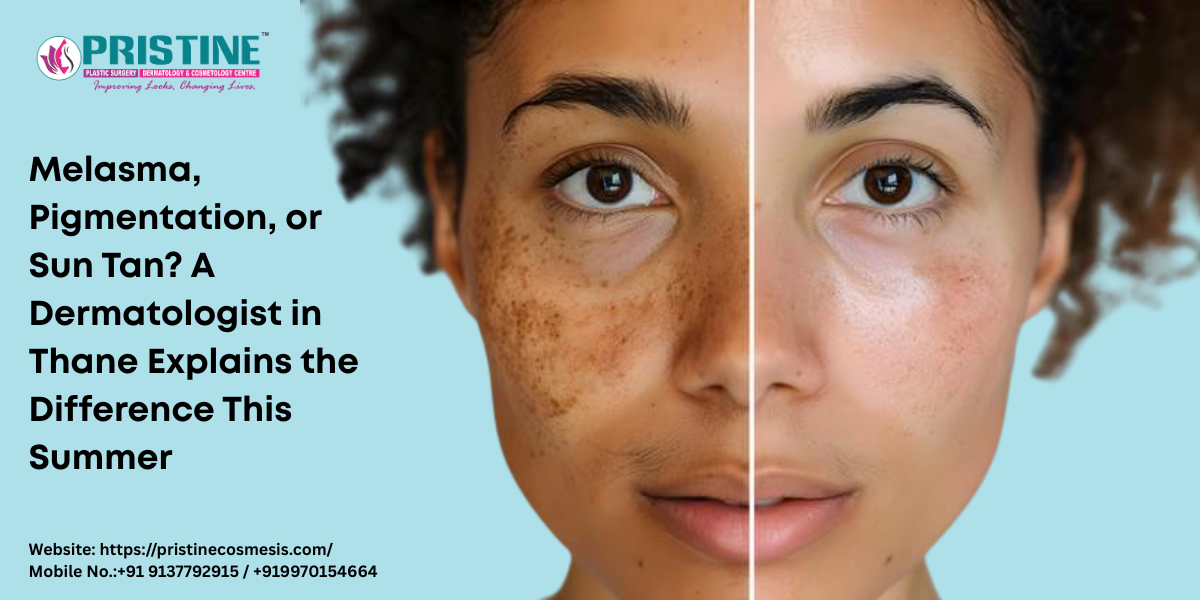
- Symmetrical brown or greyish-brown patches — usually on both cheeks, forehead, upper lip, and chin
- The patches have irregular borders but are distinctly bilateral — the same pattern appears on both sides of the face
- The skin texture underneath is completely normal
- It worsens significantly in summer and tends to lighten slightly during winter
Who gets it: In my 14 years as a dermatologist in Thane, melasma is overwhelmingly more common in women — particularly those who are pregnant, on oral contraceptive pills, or going through hormonal changes related to PCOS or perimenopause. The combination of estrogen, progesterone, and UV exposure is what drives melasma.
I’ve also noticed that women in Thane who commute daily — particularly those exposed to sun between 10 AM and 4 PM — tend to have significantly worse melasma simply because of the incidental UV they accumulate over months and years without realising it.
Why it’s different from a tan: A tan fades when you avoid the sun. Melasma does not simply fade with sun avoidance — though sun protection is absolutely essential to prevent it worsening further. The pigmentation in melasma goes deeper into the skin layers, which is why over-the-counter brightening creams rarely make a meaningful difference.
What actually works: Melasma management is a journey, not a one-time treatment. At Pristine Cosmesis, we typically combine:
- Prescription topicals — tranexamic acid, modified Kligman’s formula, or azelaic acid depending on the patient’s skin type and severity
- Oral tranexamic acid — in appropriate cases, this has shown excellent results in reducing melasma from within
- Controlled chemical peels — glycolic or lactic acid peels done in a clinical setting, timed carefully around summer UV peaks
- Laser treatments — used selectively and carefully, as the wrong laser on melasma can trigger a rebound flare that worsens the condition
- Daily broad-spectrum SPF 50 PA++++ — non-negotiable. No treatment works if you are not protecting your skin from UV every single day.
What doesn’t work: Expecting results in 2 weeks. Patients who see someone on Instagram claiming their melasma vanished in a week — that was almost certainly a tan, not melasma. True melasma takes 3–6 months of consistent, medically guided treatment to show meaningful improvement.
The Quick Comparison You Can Screenshot and Save
| Sun Tan | PIH | Melasma | |
| Cause | UV exposure | Inflammation / injury | Hormones + UV |
| Pattern | Uniform, follows sun exposure | Spots at injury sites | Symmetrical patches on face |
| Depth | Superficial | Superficial to mid | Mid to deep |
| Reversible? | Yes, easily | Yes, with treatment | Manageable, not fully reversible |
| Worsens in summer? | Yes | Yes — existing spots darken | Significantly yes |
| Best treatment | SPF + brightening actives | Niacinamide, peels, retinoids | Tranexamic acid, prescription topicals, peels |
| Timeline | 3–6 weeks | 2–4 months | 3–6 months |
How I Diagnose Which One You Have
When a patient comes to me at Pristine Cosmesis for skin darkening, here is what I actually do — because a visual examination alone isn’t always enough.
- Detailed history I ask about your hormonal health, contraceptive use, pregnancy history, medications, and sun exposure habits. Melasma almost always has a hormonal story behind it.
- Wood’s lamp examination A special UV light that helps determine how deep the pigmentation sits in your skin. This directly influences which treatment I recommend.
- Skin type assessment Fitzpatrick skin type matters enormously in pigmentation treatment. Treatments that work beautifully on lighter skin can cause rebound pigmentation in darker skin tones if not done carefully.
- Dermoscopy In some cases I use a dermoscope to examine the pigment pattern at a magnified level — this helps distinguish melasma from other pigmentation disorders with confidence.
This is why I always tell patients — please don’t self-diagnose and self-treat. The wrong cream on melasma can set you back by months. The wrong peel on PIH can deepen the pigmentation rather than lighten it.
What Every Woman in Thane Should Be Doing This Summer
Regardless of which type of skin darkening you have, these steps apply to everyone:
- Sunscreen is not optional — it is the entire foundation. Use a broad-spectrum SPF 50 PA++++ sunscreen every single morning, even indoors near windows. Reapply every 2–3 hours if you’re outdoors. I cannot overstate how much of my clinical work would be unnecessary if more women in Thane used sunscreen consistently every day.
- Avoid peak sun hours. In Thane, avoid direct sun exposure between 10 AM and 4 PM during summer. If you must go out, wear a wide-brimmed hat, sunglasses, and sun-protective clothing.
- Stop using fairness creams from the market. Most contain harmful ingredients — steroids, mercury, or unlisted bleaching agents — that cause initial brightening followed by severe rebound darkening, skin thinning, and long-term damage that is very difficult to reverse.
- Don’t over-exfoliate. I see this constantly. Women scrubbing their face twice a day with walnut scrubs or besan packs, convinced they are removing tan. They are actually causing micro-inflammation — which directly leads to PIH.
- Start treatment early in the season. April and May are actually the best months to begin — before the UV index peaks and before existing pigmentation deepens further. By July, we are often playing catch-up against conditions that could have been addressed months earlier.
Conclusion — Your Skin Deserves the Right Diagnosis, Not Just the Right Cream
Here is what I want every woman reading this to take away.
Melasma, PIH, and sun tan are not the same condition. They don’t respond to the same treatment. And treating one with the protocol meant for another doesn’t just fail to help it can actively make things worse.
In my 14 years as a dermatologist in Thane, the single biggest reason women struggle with persistent pigmentation is not that their condition is untreatable, it’s that they spent months treating the wrong thing.
A proper diagnosis takes one consultation. The right treatment plan takes a few weeks to build. But the difference it makes to your skin and your confidence lasts far longer than any summer.
If your skin is darker this season and you’re unsure whether it’s a tan, PIH, or melasma please don’t guess. Come in to Pristine Cosmesis, consult a trusted dermatologist in Thane, and we will build a plan that actually works for your skin type, your hormones, and your Thane lifestyle.
Your skin has been patient. Now it’s time to give it the right care. Book your Consultation today with Dr. Dhanyata Ghubade-Phadte Board-Certified Dermatologist, Cosmetologist & Trichologist 14+ Years of Clinical Experience.